



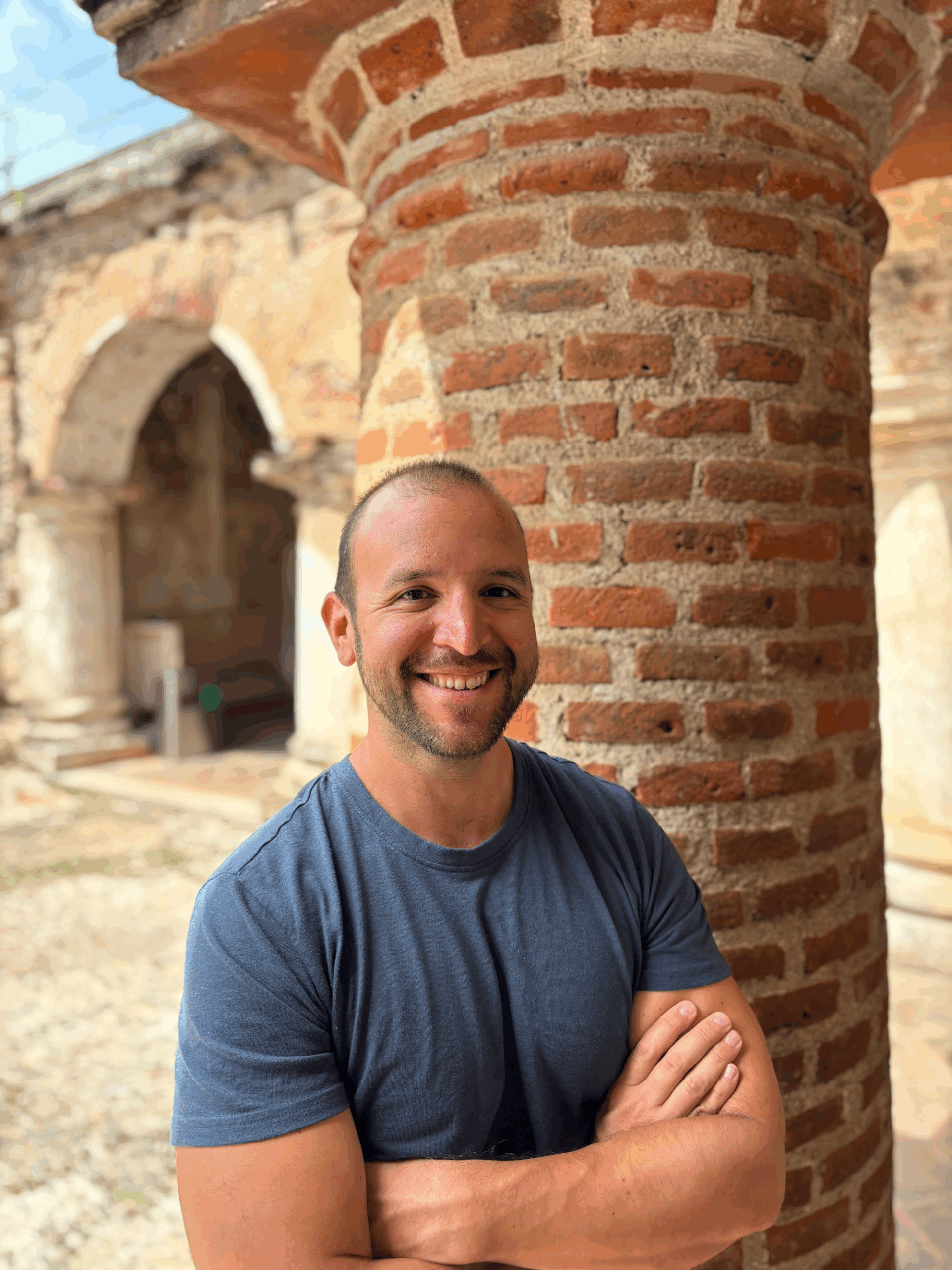
 Dr. Felipe Rojas
Associate Professor of Spanish
Study Abroad Coordinator
Elbin Library 29
304-336-8474
Education
Ph.D. in Romance Languages and Literature (Spanish) from the University of Chicago, 2014
M.A. in Spanish from Queen’s University (Kingston, ON), 2007
B.A. in Spanish from the University of Guelph, 2005
Biography
Felipe E. Rojas is an Associate Professor of Spanish at West Liberty University. He earned his Ph.D. from the University of Chicago in 2014 with a dissertation titled “Hemos visto un mal tan fiero”: The Figure of Ganymede in the Theatre of the Spanish Golden Age. His research focuses on early modern Spanish literature, with particular interests in sixteenth- and seventeenth-century theater, queer and gay studies, classical mythology, and the intersections of politics, religion, and sexuality in the Spanish Golden Age.
Much of his work explores veiled sexual references on the early modern stage and how these coded expressions engage with Spain’s political, religious, and historical transformations. His scholarship also delves into unexpected areas such as the role of children’s games in literature and their cultural significance. He has published widely on the figure of Ganymede in early modern Spanish drama, and his first monograph on the subject is forthcoming.
In addition to his solo research, Dr. Rojas is the co-editor, with Dr. Peter Thompson (Queen’s University, Canada), of Queering the Mediterranean: An Intersectional Sea of Sex, Gender, Identity and Culture (2021), a multidisciplinary collection examining queer themes across Medieval and Early Modern Mediterranean texts and contexts.
Publications
The Figure of Ganymede in Early Modern Spanish Theater. New York: Routledge, 2026.
“Juan Rana, A Sexually Transgressive Spanish Actor.” Routledge Resource Online – The Renaissance World. Eds. Kristen Poole and Montserrat Pérez-Toribio. DOI: 10.4324/9780367347093-RERW196-1 https://www.taylorfrancis.com/entries/10.4324/9780367347093-RERW196-1/juan-rana-sexually-transgressive-spanish-actor-felipe-rojas-kristen-poole-montserrat-pérez-toribio?context=rrorw&refId=b2e2e97e-421c-46c1-9bf8-025b70191646 (accessed on July 29, 2024)
“Ganymede, Narcissus and the Joys of Teasing the Pagan in Tirso de Molina’s Religious La mejor espigadera (1614).” Bodies Beyond Labels: Finding Joy in the Shadows of Early Modern Spain. Eds. Frederick A. De Armas and Daniel Holcombe. Toronto: Toronto University Press, 2024. 47-65.
“‘Más a Cristo has de imitar’: Francisquito’s (Homo)Erotic Role in Cervantes’ Los baños de Argel.” Death, Sanctity, and the Cross: Crucified Saints in Image and Text. Eds. Barbara Crostini and Anthony Lappin. Rome: Viella, 2022. 379-96.
“‘The Devil Made Me Do It’: The Dark Side of the Carnivalesque in Sendebar (1253).” Vox Medii Aevi 2.9(2021). http://voxmediiaevi.com/2021-2-rojas (accessed on July 13, 2022).
Co-editor. Queering the Medieval Mediterranean: An Intersectional Sea of Sex, Gender, Identity and Culture. Leiden: Brill, 2021.
“‘Hemos visto un mal tan fiero’: Sexual Ambiguity in Lope de Vega’s El gallardo catalán (1599-1603).” Ceræ: An Australasian Journal of Medieval and Early Modern Studies. Special Issue: Minorities and Marginalized Experiences 3 (2020): 3-22. https://ceraejournal.com/volume-7-2020/ (accessed on May 19, 2021).
“Representing An-‘Other’ Ganymede: The Multi-Religious Character of Ismael in Tirso de Molina’s La prudencia en la mujer.” Bulletin of Hispanic Studies 91.4 (2014): 347-64.
“Mirror, Mirror on the Stage: (Refl)ekphrasis in Agustín Moreto’s La loa de Juan Rana” Laberinto 6 (2012): https://acmrs.asu.edu/sites/default/files/2020-01/v6_Laberinto_Rojas.pdf (accessed on August 20, 2020).