


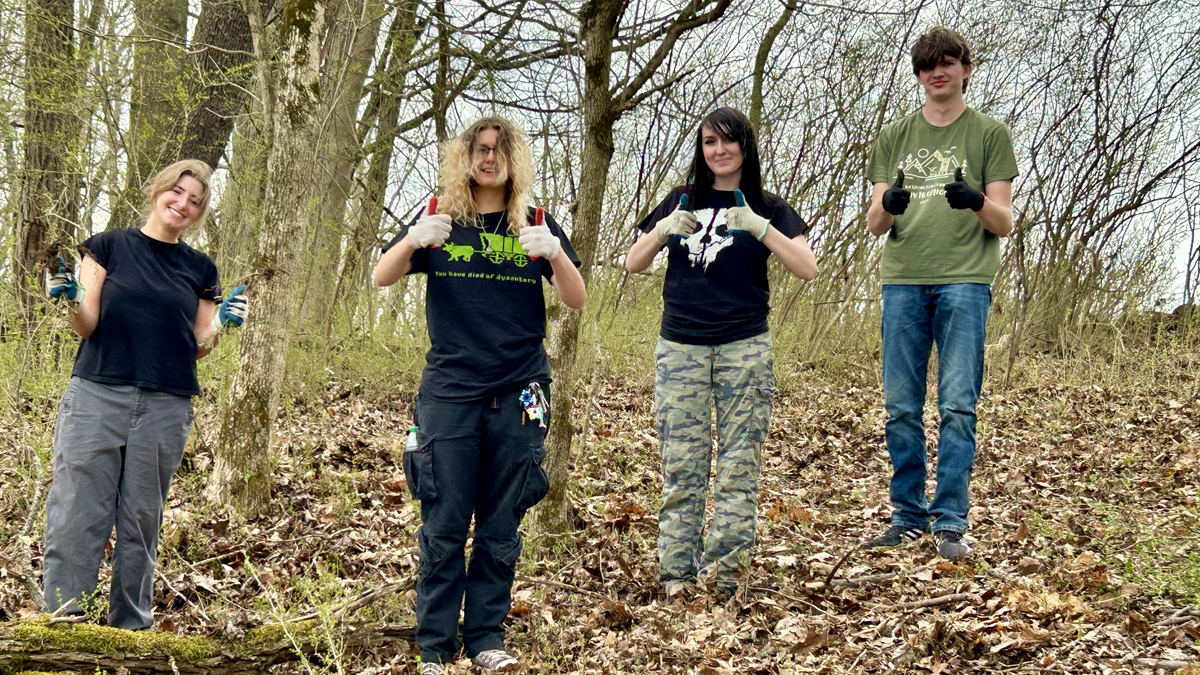
WEST LIBERTY, W.Va., May 5, 2025 – West Liberty University (WLU) biology students recently continued restoration work in the forests of Oglebay Park by removing Chinese Privet and other invasive species that have negatively impacted the Park’s ecosystem.
Begun in 2019, the project is a collaboration with the Schrader Environmental Education Center, with most of the work taking place on the trails and wooded areas behind the facility. To date, dozens of WLU students have contributed more than 500 hours to the project.
Students primarily remove Chinese Privet, an aggressive invasive shrub that pushes out native species and spreads easily through root suckers and seed dispersal by birds that consume its berries. The thick growth and rapid spread of the privet blocks sunlight, making it extremely difficult for native wildflowers and tree seedlings to grow.

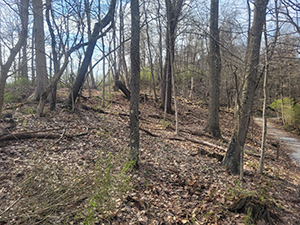
The ongoing work has led to acres of cleared areas within the forests. As WLU Assistant Professor of Biology Dr. James Wood explains, previously cleared areas are starting to see the regrowth of native flowers and ferns.
“We’ve seen native wildflowers return to the forest, including ferns, Spring-Beauty (Claytonia virginica), Toothworth (Cardamine spp.), and Squirrel Corn (Dicentra canadensis),” says Dr. Wood. “These plants provide resources for pollinators like bees and butterflies, and are an important part of a healthy environment. They also add splashes of bright colors and beauty to a relaxing walk in the woods,” he adds.

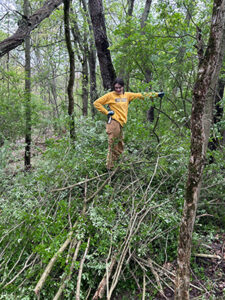
For Zoo Science Major Maddie Ray, the project has combined a love of being in the forest with doing meaningful work for the environment.
“I love spending time in the forest and knowing that removing these invasive plants makes the ecosystem happier brings a smile to my face.” They remark. “I get to be in the woods, have fun cutting down shrubs, and help the environment out all at once? Sign me up!”
The project has also been a valuable service to the nonprofit Schrader Environmental Education Center as Director Ramsay Core explains.
“Our trail system serves hundreds of visitors each week and supports a diverse array of wildlife. Its wellness and longevity are facing challenges due to the spread of invasive species,” Core remarks. “As a nonprofit organization, our limited resources make it difficult for us to effectively tackle this issue alone. With WLU’s assistance, we are finally making meaningful progress in our efforts to remove these invasive species and restore the health of our ecosystem,” he adds.
Other service projects being performed by Dr. Wood’s classes include a long-term restoration project on the Ohio River Islands National Wildlife Refuge on Wheeling Island and planting native trees to help beautify WLU’s campus.
West Liberty University’s Department of Biological Sciences is where opportunity meets excellence through hands-on research, experiential learning, and unique opportunities in both undergraduate and graduate programs. Students are guided by renowned professors with one-on-one instruction and gain essential skills for success in a variety of biological fields. Learn more at westliberty.edu/biology.